

Many communities are currently working onfillingEDRA, but in practice, it is the preparation of address data that takes the most time: checking information, eliminating duplications, correcting technical errors and forming correct exchange files.
More details about the preparation of exchange files for filling the EDRA:https://magneticonemt.com/adresnyj-rejestr-hromady/
Get a free consultation:https://magneticonemt.com/about-us/contact-us/#form_contact-us
Why the preparation of address data is important for EDRA
The unified state register of addresses is formed as a single database of up-to-date address information. Work with it is provided within the framework of the experimental project approved by the Resolution of the Cabinet of Ministers of UkraineNo. 254 dated March 5, 2024.
For the community, the high-quality preparation of the address register is of practical importance. The more accurate and structured the address data, the easier it is to undergo verification, correct errors, and further use this data in the work of the local self-government body.
MagneticOne Municipal Technologies helps communities systematically work with the filling of the Unified State Register of Addresses: from the analysis of the existing address database to the preparation of exchange files and technical support of the process.
Results of our clients for May
The experience of communities with which we have already worked shows: after quality preparation of address data, error checking and formation of correct exchange files, the level of verification can increase much faster.
In the communities that worked with our help, the following dynamics were recorded in May:
— Zatyshnyansk TG, Dnipropetrovsk region —+55,9%;
— Pluzhnensk TG, Khmelnytskyi region —+30,7%;
— Novopokrovsk TG, Kharkiv Region —+77,2%;
— Skorykivska TG, Ternopil Oblast —+31%— Monastyriska TG, Ternopil Oblast —+34,2%These results show that even with a complex or unstructured address base, the community can gradually increase the level of verificationEDRA, if the data is prepared correctly.
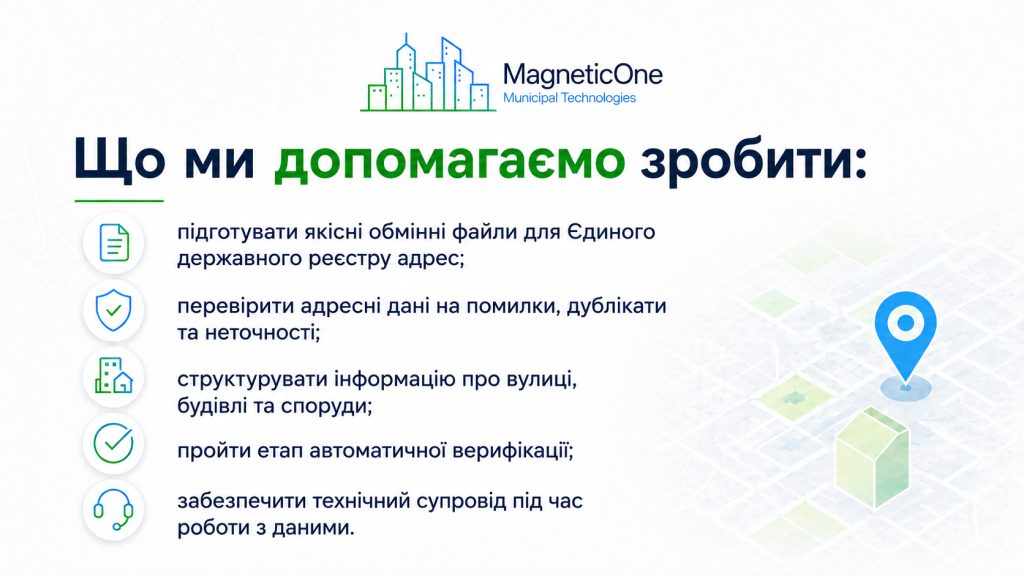
MagneticOne Municipal Technologieshelps the community go through the entire process systematically: identify building addresses, organize the address register, prepare high-quality exchange files and provide technical support for their uploading toUnified state register of addresses.